One at a time.

I’ve done something highly uncharacteristic this week: I quit!  I gave notice that this is my last year in Comp Lit at UC Davis, and instead of taking a PhD qualifying exam this Spring, I am taking an exam that will grant me a Master’s.  A Master’s and then…  Terrifying, dizzying, absolute freedom!

I say “uncharacteristic” because I am not a quitter.  I don’t necessarily say this with great pride; I simply don’t have the mental apparatus that allows me to let go of things.  In life so far, I’ve been tested in ways that have developed my blind tenacity–to the point where it can be an impediment.  So this quitting thing is new and alarming.  But holy mackerel is it ever the right decision!  The sudden evaporation of my dissertation feels like such a blessing, like a burst of air and light.  Like the gnawing on my brain has mercifully stopped.

I simply do not have what it takes to produce two totally different kinds of books on two parallel tracks for the rest of my life.  If I were to keep writing academic criticism it would severely limit my fiction output.  I was okay with this waning process when my investment in fiction was strictly personal.  Now that the layout of my life has changed so dramatically, I will not spend the energy I would have spent on novels writing scholarly works.  Hell no.

When I got the book deal last June, I tried to talk myself into staying on the academic track by telling myself that dissertating (and writing critically presumably for the rest of my life) would provide me with a needful framework of discipline.  After all, I had been investing myself in this career for a few years and it wasn’t going to simply explode out of existence.  Still, I’ve been haunted for months by this “needful discipline,” and its blood-draining effects…  “Discipline,” definitely–“needful?”  I no longer think so. These days I need vitality and passion more than I need structure.  The tamer may have a stage, a stool, a whip–yet he has nothing but a hollow pantomime if he doesn’t have the goddamn lion.

Besides, when the well runs dry and things are going badly, I don’t think I can handle the terrible weight of being utterly impotent at two kinds of writing.  I will fail at just the one, thank you.  I am not Giles Corey!  I do not want more weight.

So, I’ve been giving notice to the professors in my department.  Some are disappointed, some are fly free, little bird! I am now reading for my MA examination in the Spring instead of my PhD quals, and I like the sound of “MA.”  It sounds so wonderfully…  finite.  Still, only in academia can you tell everyone that you quit and still have 5 months of work to do.

So, I will have plenty time to practice and get used to this thrilling new quitting thing–for instance, on Monday I will go on an ecstatic orgy of returning no-longer-necessary dissertation-related books to the library.  (And it will be a fine orgy indeed; I have enough in my piles here to fill up a fairly sizable wheeled suitcase.)  Oh, those thick critical volumes written in ice-pick-to-the-soul prose will make such a sweet melodious sound on the way down the chute… It will feel so good I will have to make it last; I will feed the books to the library’s gaping metal maw

one

at

a

time.

The chute from the other side: doesn't it look like Literature got liquored up and puked all over the floor?

In the sausage factory

I’m going to take a break in the middle of a pile of grading to talk about spiffy writing stuff.  (I love teaching but oh my God, the grading–it hurts.)

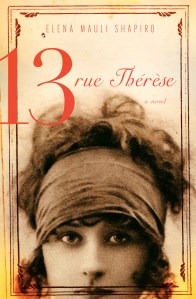
13 rue Thérèse is wending its slow way through the digestive system of the Little Brown entity (wait–this would make publication defecation, but it’s too late to turn back now, I’m committed to this gross analogy), going through all the biological and chemical processes that turn a manuscript into a book.  I’ve seen a spec cover for it, and it is cool.  Frustratingly, I am not allowed to post it, because it is still super secret.

A development that tickles my heart: the book now has an ISBN number!  Seeing those 13 digits is like seeing the inky footprint of your new baby on the birth certificate.

Also, cool multimedia ideas are happening.  My editor mentioned the prospect of putting QR codes in the book, which are basically barcodes that look like runes that take you to a website when scanned by a computer or phone camera.  These codes would link to additional content, or sound files of me reading some of the letters aloud, stuff like that.  I am thinking it would be fun to have fragmentary mini-stories that are interlinked in unexpected ways, like a little internet labyrinth.  It’s an interesting new medium to exploit.

Also, my kickass agent and my awesome editor have asked me for short stories to submit to The New Yorker‘s summer fiction issue.  The odds that I’ll get in are quite low since I am such fresh fish but it is still pretty damn exciting to put together a solicited submission to the Holy Grail of literary magazines, which will likely be read by an actual editor instead of a glaze-eyed intern with a finger poised on DELETE.  (Note that I am not talking smack about the glaze-eyed intern; I’ve had the job of reading through slush piles and it is deadening.)

I should get back to grading…  Don’t wanna.  Hold me!

Thinking too small

I finally saw Avatar today.  Visually, it was stunning–but I was hoping that a movie that took a decade and half a billion dollars to make would have a tighter script, and better editing.  (It was nearly three hours long, and in the last hour of endless nonsensical violence I leaned over and asked my husband how long this movie was going to be, for my brain was numbed and my bladder was full.)

What offended me about this movie wasn’t that it was derivative claptrap (I was sort of expecting that).  It was the perniciousness of its self-congratulatory message.  It reveled so unabashedly in the toxic meme of the Noble Savage that even the shade of Jean-Jacques Rousseau was like, really, no shit? The natives are such beautiful innocent children at one with nature, and did you know that, like lovebirds, they mate for life?  And of course, being beautiful innocent children, they must be saved by a Great White Messiah who understands the loveliness of their simple ways–a Great White Messiah who is so awesome that he is better at being them than they are after hanging out with them for three months.  Gag.

The characters are all shallow cutouts who seldom resemble actual human beings, but I suppose I can forgive that because the story is supposed to be a heavy-handed allegory, and thus presents only archetypes.  (The noble blue savages are a cultural mishmash of various American Indian, African, and Asian tribes, signifying Everything that is Not White in a way that would have made Edward Said whimper.)  Allegories use archetypes as shorthand to dramatize conflicts between various drives inside the human animal, but the movie still failed on that count because the archetypes were not even internally consistent.

For instance:

The premise of the movie is that a corporation is trying to colonize the beautiful alien jungle filled with beautiful alien children in order to mine some precious element called–I shit you not–unobtainium.  The Corporate Hack takes the advice of the Evil Soldier in deciding to exterminate the Noble Savages and level their Idyllic Forest despite the Benevolent Scientist desperately trying to tell them that the Idyllic Forest is a sentient God that can literally be accessed by a brain USB cable that snakes out of the back of one’s head.  Corporate Hack says “kill everyone and burn everything” because he is jonesing so bad for that tasty unobtainium–but what kind of piss-poor Corporate Hack is he?  How fucking marketable a commodity would it be to be able to plug yourself into Mother Earth and communicate with God?!  And how about the anti-gravity fields that make freaking mountains float in mid-air?  Those cool-ass levitating jellyfish dandelion seed thingies would sell way better than sea monkeys!  Come on, Corporate Hack, you’re thinking too small!

(Let me take a moment to express my gratitude, however, for the fact that when our Great White Messiah finally makes love to his feisty-yet-sweet forest nymph in the Sacred Humping Grove, we are not actually subjected to a graphic sex scene in which they merge USB ports or whatever.  But–I’m sure that’s coming in the director’s cut.)

Another internal inconsistency that bothered me was the idea that the Noble Savages could plug into various wild animals with their USB ports and make them do their bidding.  It would have been more consistent with the message of the movie if, when plugged in, they were one with the horse or some such new age faux-buddhist thing–but no, they literally telepathically order the animals around, and the animals have no choice but to comply.  One inadvertently funny scene features our hero, in his manhood-induction ceremony, picking out a pterodactyl dragon to ride and call his own.  The forest nymph informs him that not only must he choose his dactyl, the dactyl must also choose him.  He asks how he can tell that the dactyl has chosen him, and she replies that it does so by trying to kill him.  Well, sounds like consent to me!

So, you know, all that stuff about unity with Gaia and singing mourning songs when you kill animals for food rings a little hollow when you enslave them with your USB ports.  Maybe James Cameron was making some sort of canny oblique statement about the dangerous hypocrisies that pop up in religious belief systems but somehow, I don’t think so.  The allegory was so heavy throughout that my soul felt violated (really, I think James Cameron wrote this script because he was convinced that he needed to serve a market that found Dances with Wolves too subtle).  It also used bits of 9-11 imagery in somewhat troubling ways, but I will not open that can of worms.  I will instead go to bed, and dream of buying a sachet of those cool levitating jellyfish dandelion seed thingies–you know, they would be dehydrated in a little packet that would read: “just add water and you too can be Chosen by the Great Mother!”

Academic prose, or the glandular secretions of skunks

Sometimes I really love academia, and sometimes I wonder what on Earth I’m doing here.  The latter usually happens when I’m reading some chunk of academic prose that is crushing the life out of me.  After torturing my poor bruised brain attempting to pummel meaning out of long byzantine sentences, I wonder, is this really necessary?  It hurts.

Sometimes I marvel at the precision of academic language, how it can explicate something complex and specific, lay it out like a blueprint in words.  A lot of the time though, I groan and whimper and bristle with irritation: I could whittle down that entire bloody brick of a paragraph into a single sentence to say the same thing, a single sentence that would be a lot clearer and would not make little baby Jesus cry! I guess when it all comes down to it, I am merely a word economist.  I admire prose that gets from point A to point B efficiently.  If it takes detours, it better be damn pretty.  Academic prose generally isn’t.

I also find academic prose problematic because it’s such an unapologetic display of power.  When it’s good and unpacks some essential truth concisely and cleanly, it does earn my begrudging admiration.  When it’s bad and lays down layer after layer of gratuitous verbiage that one must peel back to reach some simple idea, it just pisses me off.  I will never get those precious minutes of my life back–and why?  So that the author could say: I am one of the educated elite, and for you to understand what the fuck I’m saying, you must be too. Sometimes I think it would save a lot of time if that statement were a disclaimer right under the title of the work in question (and remember it’s not really a title unless it’s two lines long and has a colon in it).

My problem is that I am an incorrigible aesthete.  I’ve been told by several professors that I approach writing as an artist rather than a scholar (which is not necessarily a compliment, for some academics it’s an unfortunate condition that one must work around).  It’s true, so much of writing for me is seduction.  It is an attempt to arouse the senses with sheer loveliness; the ideas are sort of incidental.  Or rather, the prettiness turns you on to the ideas.  A spoonful of sugar makes the medicine go down and all that.  Academic prose refuses to give you that spoonful of sugar.  As a matter of fact, it likes to coat the medicine with the glandular secretions of skunks to make sure you really want to take it.  If you don’t make yourself choke down something repellent along with the medicine, how can it know you are worthy to swallow it?

It’s the exclusion that chafes me.  I am a plebian like that.

A door Jedi

I taught Sartre’s No Exit today.  It went well; it’s a pretty serviceable text: content-rich yet easy to unpack, and fits neatly inside one two-hour session.  Existentialist fiction is too messagey to blow me away as art (I’ll never well up in ecstatic admiration at the glittering diamond-like structure of The Plague, for instance) but it’s a good way to start the quarter, get the students thinking–but not too hard at first.

The students are not yet laughing at my quips, but they will warm up eventually.  It always seems to take them a few sessions to get used to my sense of humor, partly because I don’t give them laugh cues.  I don’t laugh at my own jokes because doing so decreases their entertainment value by a good 80%, consequently the students are not sure at first if I mean to be funny.  They risk a few cautious titters.  I learn to read what they are likely to react to (you’d be surprised how much it differs by group).  Slowly we warm up to each other.  Even after we are comfortable together, their mirth is mostly subdued, which makes the rare instances when I get a genuine burst of hard laughter from the entire room all the more satisfying.  It’s great when it happens, it bonds the room together.  Not to mention it makes me feel powerful.

(And how often in one’s daily life does one feel powerful?  Sometimes I like to gesture at automatic doors to open a half-second before they do so, it makes me feel like a Jedi.  Although it is tremendously disheartening when the door is out of order.)

Barbarism vs. Decadence

I had a delicious osso bucco for dinner.  My husband said, as he watched me sucking chunks of bone marrow directly from the knife blade: “that is very decadent of you.”

I said, “no, this is barbarism.  If I were being decadent, I would have the bone marrow fed to me on a filigreed platinum spoon by a eunuch wearing a purple silk loin cloth embroidered with children’s dreams as I lounged on an ivory chair wearing a dress made of gilded hummingbird feathers, with my feet resting on a live sea tortoise encrusted with eyeball-sized emeralds.  Then I would slide said feet, their toenails painted with a polish made from black coral and the death rattles of clubbed seal pups, into my kitten fur slippers and go defecate the bone marrow into my solid gold toilet while reading a copy of Star magazine printed on pressed orchid petals with ink expressed from the blood of bald eagles.  Then I would have the eunuch wipe my ass with the pelt of a Siberian white tiger and moisturize it with passion-flower-scented whale blubber.”

He said, “oh.”

Then we had chocolate cake.

Indeed quite lovely

I watched this rather fascinating documentary on the French channel in my cable package called Le Crazy s’enflamme about the Parisian cabaret Le Crazy Horse.  It featured the process of putting together one of their artsy nudey shows, from the auditions for new dancers to the finished product.  The rigors these girls went through were amazing, from the relentless rehearsals to the necessary sacrifice of personal relationships.  It made me wonder why these women dedicated themselves to their dancing to the detriment of all else, almost the way nuns marry Jesus.  Why go through all of this just to become a disposable piece of unrecognizable ass to be discarded at the first signs of aging?

There was a bit of background on the cabaret, how it came about during France’s mid 20th century explosion of love for all things American.  The founder was Alain Bernardin, and he was of course banging a great number of his dancers.  He looked a bit like the French Hugh Hefner.  If there is a single visual that thoroughly embodies the patriarchy, it would be a jolly-faced older man enjoying a parade of gorgeous young duplicate women, an undifferentiated mass of nubile female flesh without end.  The individual female can’t stay long in the spotlight; the moment a laugh line or ass dimple shows up on her, she disappears.  So why would an individual female subject herself to this treatment?

In the case of Hugh Hefner’s mansion show ponies, the answers present themselves easily: a shot at fame, a comfortable life, money.  For the girls at the Crazy Horse the motivation is less obvious.  They do not get paid much (following one home, we got to see her modest apartment in the banlieue), and they will not be famous.  The whole point of the show is the multitude of perfect identical bodies, these girls do not get individual faces.  Is it just that they want to be admired?  But the audience is not admiring them, it is admiring an idea.

Perhaps it is the idea, then, that draws them.  The mythos of the place, the artistry of the shows, what it means to be one of the bodies that form The Body.  At some point in their formative years they saw in the cabaret a picture they wanted to be in, like a boy who sees a line of upright men in tidy uniforms and wants to be in the army when he grows up.  The singular desire to embody an idea drives them through the strain of their daily grind.  Certainly, they are artists.  But the simile I used two sentences ago highlights the fluidity of what the word “artist” means–are soldiers, too, artists?

Some images, for they are indeed quite lovely:


Without glass

Hello.  My name is Elena.  I have a novel coming out Spring of next year.  I teach intro literature at the University of California.  I will now begin open letters to the world.

This blog is under my real name, and will be indexed by search engines.  How alarming!  I thought of the prospect of being found by students and nearly scrapped the whole idea.  But why not try this out, after all?  It is doubtful that I will suffer from some kind of online Tourette’s and post naked pictures of myself or some such.  This openness is a bit daunting though.  It will take some getting used to.  I’ll view it as practice public speaking for when the book comes out.  By that fateful date, maybe this small forum will have given me some degree of comfort with exposure.

It’s true that, as a teacher, I do a fair amount of public speaking.  Speaking as an author is not the same though.  As an instructor I am not so much a person as a channel for the text.  Certainly, the interpretations I present are tinged with me, but I am not the point.  I’m a means to an end, a guide meant to help my students reach their own understanding of the book at hand.  I am the Virgil to their Dante.

When I speak as an author I am not granted the safety of the outside text.  There is no medium with which I can blend, that I can disappear into so that it is comfortably impossible for my audience to tell the difference between the thing they are looking at—the text—and the thing they are looking through—me.  Oh shit, I’m becoming the primary source!  I am no longer Virgil; I am Hell.  No longer the guide but the landscape.

If there were a paper bag within arm’s reach I would be breathing into it right now.

When I was in college, I worked for tuition money as a bank teller.  I had posts in several different branches of the same bank.  Only one featured bulletproof glass.  I noticed when I finished a day at that place that I was immensely less tired than after a day at an unshielded teller window.  It was so different, so much less draining to speak to the customers through two inches of plexiglass.  I couldn’t smell them; they couldn’t touch me.  It was so much tidier and less dangerous.  It was also necessarily a lot less interesting, less human.

Onwards then, without glass.